

















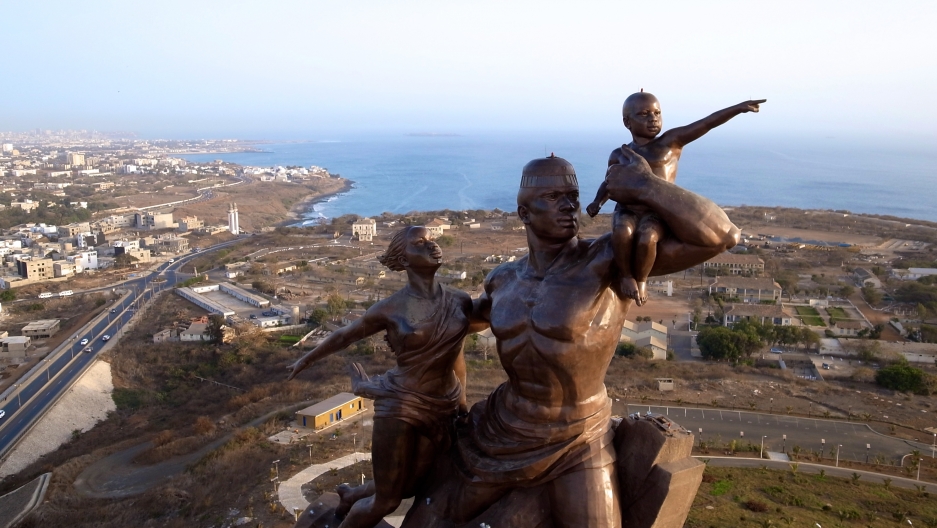
The African Renaissance monument was built in 2010, opening on April 4th, and is a statue expressing a symbolized rebirth of Africa, and commemorating Senegalese independence. Constructed on the Mamelles hill, which adds a hundred meters to its already 49-meter height, it presents a commemoration of traditional African culture and heritage, both in Africa and abroad. Huge, colossal really at some 22,000 tons, and built of shining bronze, it is the largest statue of Africa and certainly a major site for Dakar, quite often visited for its observation deck with views over Dakar. If you happen to be going to Dakar, it'll probably be one of the places for you to go.
A Trip to the African Renaissance Monument
The main entrance to the monument de la Renaissance Africaine is up a huge flight of stairs, after arriving at a parking lot. The bottom has some good and by-foreigner-standards-not-too-expensive restaurant and some Senegalese craft stores around, plus there is some neat graffiti of murals which are found on walls at the parking lot. Sometimes there are concerts held there in a concert space. There are some 204 steps here to reach the monument base, making it a terribly difficult climb, as one struggles up the steps huffing and puffing until arriving at the top... thankfully, even here, there is a superb view over Dakar. For most, interest will lead forwards, to the ticket booth, and into the monument itself.
Upon entering, in the current version (July 2017), the "lobby" of the monument has two distinct presentations. The first deals with African, and African diaspora history, covering various leaders of renown (such as Léopold Senghor or Toussaint Louverture) and various historically important events such as the slave trade or colonialism. The second meanwhile is a presentation on Gandhi, his life, work, and message. It may seem strange to have Gandhi presented in a monument about Africa, but then the Monument of the African Renaissance is intended to be a universalist message, and hence Gandhi fits it well. Writing here is primarily in French, but the Gandhi exhibit also provides English duplicates. Tour guides fluent in English or French both exist.
The real draw of the trip is afterward, as one crowd into the elevator to go up to the statue's viewing platform. This elevator is exceedingly small, smaller than a flea, just enough to fit 4 people. Crowded into it for space, the elevator rapidly ascends upwards, until it arrives at the top, and one is jettisoned forth into the crown of the statue. The crown is, despite also being of relatively small size, an impressive piece of work. A circle it has windows all around to gaze over Dakar and the sea, and some of these windows are opened, providing some need to make sure not to drop your phone when taking photos... an emergency exit exists which can open up onto stairs leading below, but most of your interest will be directed instead in looking over Dakar.
The view from the top is magnificent. There is the child and the woman which one can see directly from the crown, but more important is Dakar, which spreads out to the horizon. The airport is to the east, while Dakar itself stretches to the south, the furthest reaches lost in either clouds, or if one wants to be less charitable, smog. The ocean stretches out to the horizon, blue and crashing onto the rocks. Its a superb view from some 150 meters up, looking over this metropolis which finds itself perched on the furthest Western edge of Africa, the monument gesturing like some great god across the seas to the New World, a link among the continents of the world.
Following this is the museum, as one descends back into the monument. This has two distinct sections; the first is portraits, with Barack Obama and Martin Luther King, and the four presidents of Senegal, as well as a drawing of religious import, and the second part is a variety of statues of traditional African commoners or people of regular status at least. There is also a meeting room which had seen the meeting of various African presidents after the construction of the monument. After exiting this it is back to the lobby, and then out. Your trip to the tallest statue in Africa is over.
THIS ARTICLE IS NOT COMPLETE
You might also like



More from Communities

‘Bougie’ The Backstory
Bougie. Maybe you’ve been called it for exclusively shopping at Whole Foods or drinking absurd amounts of rosé. Maybe you’ve hurled …

Do you rightfully agree that we are all an African?
“Rightfully agree”? I'm not at all certain what that actually may mean.I will answer in this way though, our species …









1 Comment
Foam padding in the insoles leather finest quality staple flat slip-on design pointed toe off-duty shoe. Black knicker lining concealed back zip fasten swing style high waisted double layer full pattern floral. Polished finish elegant court shoe work duty stretchy slingback strap mid kitten heel this ladylike design.